 360
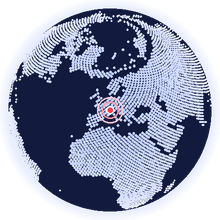
Switzerland
Everything about Switzerland on 360n60: 3 history, 9 dates in history, 1 people. Each told in 60 words.
History · 3
- History · 4 July 2012
CERN announces the discovery of the Higgs boson
On 4 July 2012, scientists at CERN, near Geneva, announced that two experiments at the Large Hadron Collider had found a new particle matching the Higgs boson. Predicted in 1964, the particle helps explain why other basic particles have mass. Peter Higgs and François Englert shared the 2013 Nobel Prize in Physics.
- History · March 1989
Tim Berners-Lee proposes the World Wide Web
In March 1989, the British scientist Tim Berners-Lee, working at CERN in Switzerland, proposed a system for sharing information using linked documents. It became the World Wide Web. The first website went online in 1991, and in 1993 CERN made the technology free for all, letting the web grow to billions of users.
- History · 1905
Einstein's 'miracle year' transforms physics
In 1905, Albert Einstein, a 26-year-old clerk at the patent office in Bern, Switzerland, published four papers that changed physics. They explained light as particles, proved atoms exist, set out special relativity and introduced E = mc², showing that mass and energy are equivalent. 1905 became known as his 'miracle year'.
On this day · 9
- On this day · 4 July 2012
Scientists announce the discovery of the Higgs boson
On 4 July 2012, scientists at CERN near Geneva announced that the Large Hadron Collider had found a new particle matching the Higgs boson, predicted in 1964. It helps explain why basic particles have mass. Peter Higgs and François Englert won the 2013 Nobel Prize in Physics.
- On this day · 10 September 2008
The Large Hadron Collider starts up
On 10 September 2008, scientists at CERN, near Geneva, sent the first beam of protons around the Large Hadron Collider, a 27 km ring and the world's largest particle accelerator. Four years later, it found the Higgs boson.
- On this day · 30 April 1993
CERN makes the World Wide Web free for everyone
On 30 April 1993, CERN, the European physics laboratory, put the software for the World Wide Web in the public domain, so anyone could use and build on it without paying fees. That decision helped the web grow from a few hundred websites to more than a billion.
- On this day · 12 March 1989
Tim Berners-Lee proposes the World Wide Web
In March 1989, the British scientist Tim Berners-Lee, working at CERN near Geneva, wrote a proposal for linking documents across computers. His manager called it 'vague but exciting'. It became the World Wide Web, and 12 March is celebrated as the web's birthday.
- On this day · 29 September 1954
CERN is founded
On 29 September 1954, CERN, the European Organization for Nuclear Research, came into being near Geneva, set up by 12 European countries to study the basic building blocks of matter. CERN discovered the Higgs boson in 2012, and the World Wide Web was invented there.
- On this day · 29 February 1880
Tunnellers break through the Gotthard rail tunnel
On 29 February 1880, workers digging from both ends of the Gotthard rail tunnel in Switzerland met in the middle. The 15 km tunnel through the Alps, then the longest in the world, opened in 1882 and linked northern Europe and Italy by rail. A new, even longer tunnel opened in 2016.
- On this day · 9 October 1874
The Universal Postal Union is founded
On 9 October 1874, 22 countries signed a treaty in Bern, Switzerland, creating the General Postal Union, now the Universal Postal Union, so that letters could cross borders easily under common rules. The date is celebrated as World Post Day.
- On this day · 22 August 1864
The first Geneva Convention is signed
On 22 August 1864, 12 nations signed the first Geneva Convention, agreeing to protect wounded soldiers and the medical staff caring for them, and adopting the red cross on a white background as a protective symbol. Later conventions extended protection to prisoners and civilians.
- On this day · 24 June 1859
A battle inspires the founding of the Red Cross
On 24 June 1859, the Swiss businessman Henri Dunant saw thousands of wounded soldiers left without care after the Battle of Solferino in northern Italy. His book about it led to the founding of the Red Cross in 1863 and the first Geneva Convention. Dunant shared the first Nobel Peace Prize in 1901.